

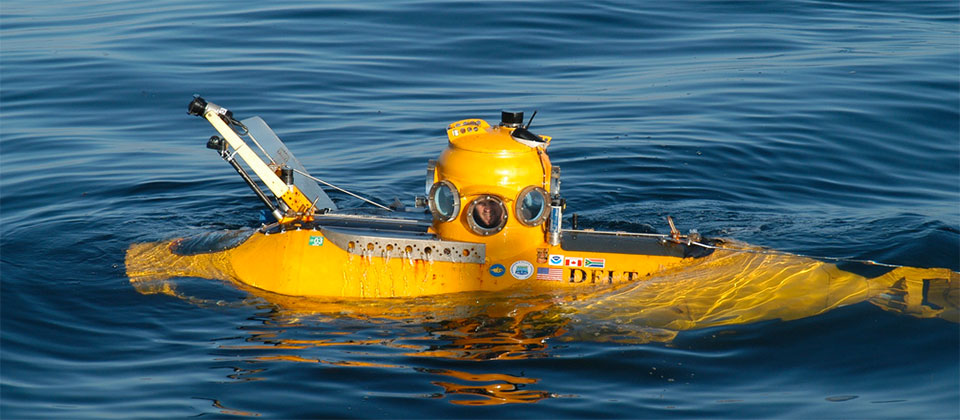
Scientists monitor marine life and habitats to detect changes in ecological communities and environmental conditions.
Measuring current conditions against long term data sets can tell us how ecosystems change over time, in response to restoration efforts, or in response to stressors such as invasive species, habitat alteration, climate change, or ocean acidification.
Most sanctuaries have monitoring programs tailored to the information needs of the sites. In addition, some monitoring activities apply to more than one sanctuary. Click here to find out more about Monitoring within the National Marine Sanctuary System.
At Cordell Bank National Marine Sanctuary, our goal is to monitor habitats and communities on the rocky habitat of Cordell Bank, the soft sediment surrounding the bank on the continental shelf, in Bodega Canyon, and in the pelagic (open ocean) environment to detect changes over time, changes that are in response to stressors, and recovery of species from overfishing due to regulatory changes. We use technology such as remotely operated vehicles and research vessels to do this work and we collaborate with partners at universities, and private and non-profit institutions. Below, you can read about some of our monitoring projects. You can also visit the Sanctuary Integrated Monitoring Network (SIMoN) to learn about research and monitoring projects within Cordell Bank, Gulf of the (now "Greater") Farallones, and Monterey Bay national marine sanctuaries.
Applied California Current Ecosystem Studies (ACCESS)
Learn more about the ACCESS program on our research webpage. ACCESS is a joint research and monitoring program with Point Blue, Cordell Bank National Marine Sanctuary, and Gulf of the (now "Greater") Farallones National Marine Sanctuary.Cordell Bank Ocean Monitoring Program
 The Cordell Bank Ocean Monitoring Program (CBOMP) collected information on the spatial and temporal variability in the oceanographic system of the Cordell Bank region from 2004 to 2010. Physical and biological characteristics of the pelagic system were measured monthly along transects using a CTD (vertical profiles of salinity, temperature, chlorophyll-a, light levels), TSG (continuous surface values of salinity, temperature, chlorophyll-a), and EK60 echosounder (continuous measurements of relative abundance of zooplankton), while marine birds and mammals were recorded by observers. In addition to biological observations, floating marine debris, categorized by type, was recorded along transects. Phytoplankton samples were also collected that contributed to the Marine Biotoxin Monitoring and Control Program, which is managed by the California Department of Health Services and is a state-wide program designed to detect toxin producing species of phytoplankton in ocean water before they form a potential toxic bloom and impact the public. Starting in 2010, CBOMP was replaced by the Applied California Current Ecosystem Studies program (ACCESS) in partnership with Gulf of the Farallones (now "Greater") National Marine Sanctuary and Point Blue Conservation Science..
 Reports
Pyle, P., B. Becker, C.Keiper, M. Carver, D. Howard. 2005. Cordell Bank Ocean Monitoring Project (CBOMP): Goals, methodology, and 2004 results. 17pp. (684k pdf)
Pyle, P., M. Carver, L. Etherington. 2008. Methodology for debris monitoring during at- sea observation programs in West Coast National Marine Sanctuaries. Final report to NOAA Marine Debris Program. 8pp. (208k pdf)
Presentations
Etherington, L., P. Pyle, M. Carver. 2007. Seabird abundance at Cordell Bank, CA associated with changes in regional oceanographic conditions. Pacific Seabird Group Meeting, Pacific Grove, CA. (1.1M pdf)
Pyle, P., M. Carver, C. Keiper, B. Becker, D. Howard. 2005. Cordell Bank Ocean Monitoring Program (CBOMP).
Sanctuary Currents symposium. Monterey, CA. (596k pdf)
Cordell Bank Buoy Oceanographic Observations
 The Cordell Bank Buoy was a collaborative project between Bodega Marine Laboratory and Cordell Bank National Marine Sanctuary from Spring 2007 - Summer 2013. The buoy was comprised of sensors measuring water temperature, salinity, turbidity and chlorophyll fluorescence. The mooring was placed at 85m depth, on the northern part of Cordell Bank, about 20 nautical miles west of Point Reyes. This buoy provided data that are linked with regional coastal ocean observing systems, including the National Marine Sanctuaries West Coast Observations program, and have been used by Cordell Bank National Marine Sanctuary staff, research oceanographers, and local communities to better understand offshore ocean conditions.
Partner
University of California-Davis,
Bodega Marine Laboratory
Data Access
Bodega Ocean Observing Node Website